
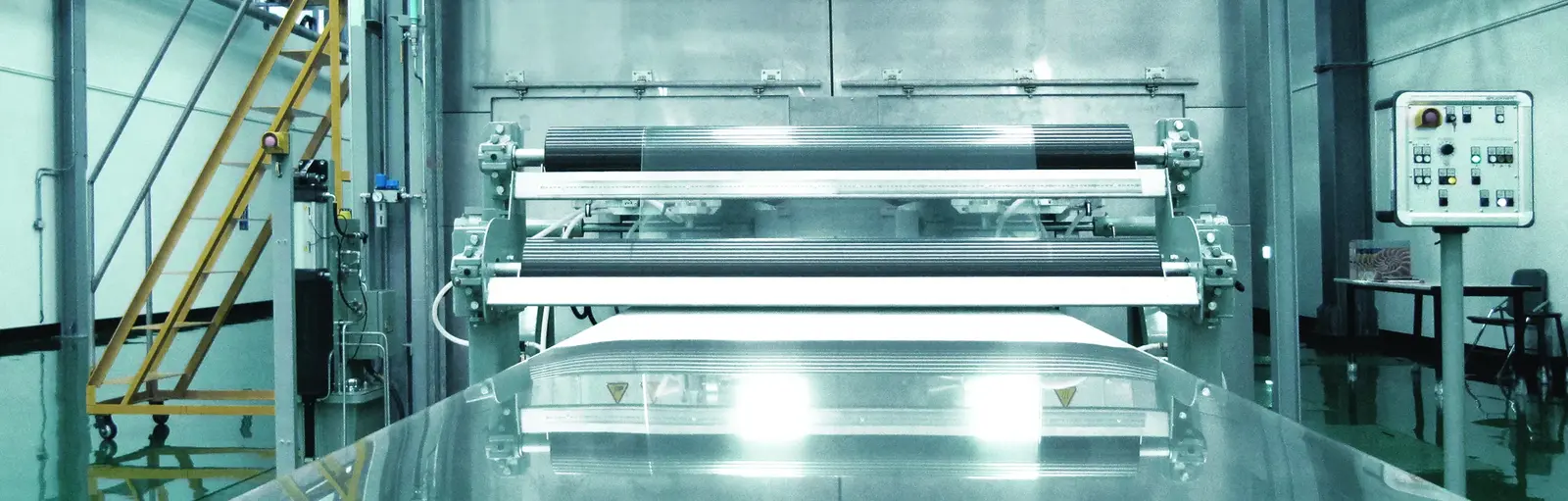
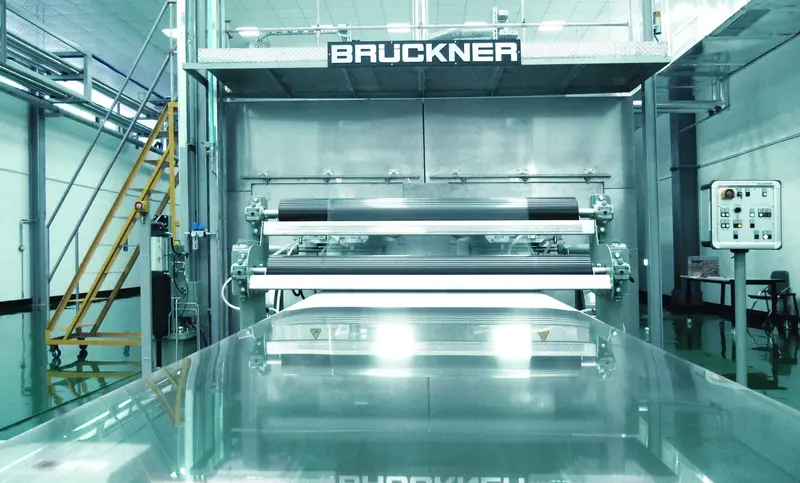
For Brückner Maschinenbau, one of the world’s leading suppliers of production lines for biaxial oriented films, this became the key issue: rethinking engineering – not discipline by discipline, but as an integrated end-to-end process.
“Simply replacing our electrical CAD system would have been far too short-sighted,” says Sven Börner-Sachs, Group Leader Electrical CAD and Product Owner “Engineering Base” at Brückner Maschinenbau. “We wanted to structurally improve our processes across mechanics, electrical engineering, and software.” The answer: Engineering Base from AUCOTEC.
A platform instead of isolated solutions
Brückner has been working with Engineering Base for many years. From the outset, the goal extended far beyond schematic creation: the company sought a centralized, data-centric engineering model.
Today, mechanical design, electrical engineering, and software engineering all work on the same data foundation. Functional mechatronic equipment modules are already defined during the mechanical design phase and form the basis for the electrical implementation. Circuit diagrams, P&ID elements, and automation information are generated consistently from one shared engineering model.
“Our job is not just drawing circuit diagrams,” explains Börner-Sachs. “Together with mechanics and software, we first develop a continuous functional model of the machine. Engineering Base is our central platform for that.”
The software department accesses the Engineering Base model automatically via web services and directly uses the data for automation engineering. Media discontinuities are eliminated. Duplicate data entry disappears as well.
Step-by-step transformation with a clear strategy
The migration to Engineering Base was deliberately not approached as a big-bang project, but carried out machine by machine. Production lines comprising several thousand schematic pages are being successively migrated.
“With every machine, we learn something new,” says Börner-Sachs. “We quickly realized that this was not about simple conversion. We intentionally redesign the engineering – based on a structured data model, not just black lines on a white background.”
At the same time, the system transition became an opportunity for strategic consolidation. Every drawing page was critically reviewed: Is this still state of the art? Can it be implemented in a more modular, efficient, or installation-friendly way? This “housekeeping effect” is paying off – both technically and organizationally.
Modularization as a productivity driver
One of the key success factors is Brückner’s consistent modularization strategy based on so-called “Typicals.” Functions are defined interdisciplinarily before project execution begins, with clearly specified variants and options.
“We discuss very precisely in advance which variants are truly required,” explains Börner-Sachs. “Everything we regularly need in our projects becomes part of the standard. Historical one-off solutions are no longer standardized. Our objective is clear: as much standardization as necessary, as lean as possible.”
Based on this approach, the Advanced Typical Manager (ATM) within Engineering Base automatically generates large parts of the documentation. While 100 percent automation is unrealistic for highly customized special-purpose machinery, the majority of standard engineering content can now be created reproducibly, quickly, and with consistently high quality. This enables project teams to focus their expertise on customer-specific requirements and innovation.
The results are measurable: significantly reduced engineering time, consistently high planning quality through standardized typcials, reduced susceptibility to errors, and extensive reusability across projects.
“The gains in efficiency and quality are absolutely evident,” summarizes Börner-Sachs. “Well-prepared typicals are the foundation for fast and high-quality project execution.”
A digital model with lifecycle relevance
During engineering, installation, and commissioning, Engineering Base provides a complete and continuously updated representation of the plant status. Material numbers, bus structures, cabinet layouts – everything can be centrally traced and managed.
For production lines designed to operate for several decades, this consistent data foundation is essential. Changes are documented in a structured manner, while variants remain fully transparent and traceable.
“Within the Engineering Base model, we have a true digital representation of the plant,” says Börner-Sachs. “That gives both us and our customers tremendous confidence.”
A partnership built on shared thinking
For Brückner, Engineering Base has long evolved beyond a traditional CAE system. The platform supports the company’s standardization strategy, enables scalability for highly complex production lines, and creates a stable foundation for future requirements.
“AUCOTEC’s mindset fits perfectly with ours,” emphasizes Börner-Sachs. “Connectivity, platform thinking, no isolated solutions – this goes far beyond a purely business relationship.”
The long-standing collaboration demonstrates how companies that think modularly, structure data consistently, and organize engineering across disciplines can create sustainable competitive advantages. Or, as Börner-Sachs puts it: “Engineering Base gives us the structure we need to make highly complex machinery manageable.”